The following is a post I published to Cohost on November 22nd of 2022, during the development of Letter to the Golden Witch.
Cohost is awash with colored text right now. Rainbow text, glowing text, every
color under the sun, we’re all doing it. It’s all the rage.
As an Umineko reader and writer, I have my own thoughts on colored text that I want to share. This will be a big post.
Umineko spoilers lie ahead! There are no explicit, major spoilers, but you should still be careful – and you’ll need some familiarity with Umineko as a work to understand what the hell I’m talking about. You have been warned.
Everything I speak in red is the truth!
Umineko is a story about mystery fiction and the relationship between reader and author. Even at a surface level, it’s just dripping with these themes: not only do the characters themselves literally take part in this dichotomy, but some characters even play both roles at various times in the story.
Even now, over a full decade since Umineko reached its conclusion with Twilight of the Golden Witch, readers are still discussing the story as it relates to both living human author Ryūkishi07 and the various diegetic authors that exist at various layers within the work itself.
This theme finds its way into Umineko in less explicit forms, too: red truth (and by extension the detective’s privileged perspective) are metaphor for both the mystery genre narrator and the reader’s trust in that narrator. Likewise, blue truth represents the theories that the reader forms while reading; that is, the reader’s form of communication with the author.
Battles between the two thus turn the writer-reader relationship into explicit back-and-forth action. It’s a perfect fit for Umineko thematically, so it’s no wonder that so much of the story focuses on these battles of truth and logic.
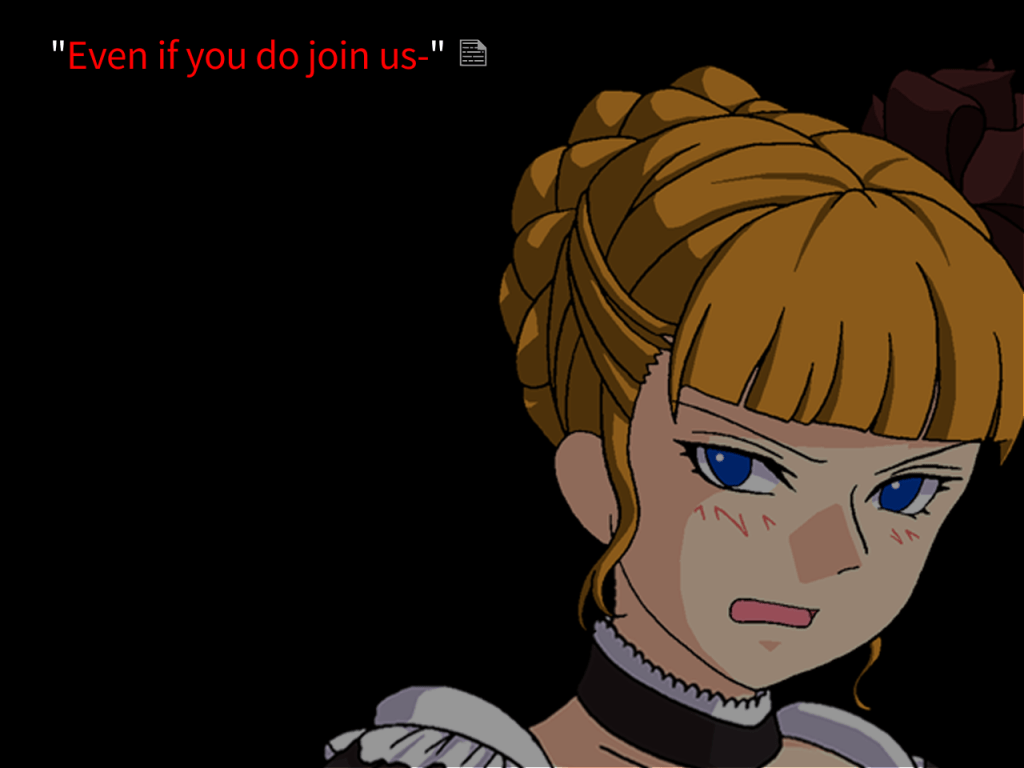
Red truth ends up defining much of the reader’s experience. From Turn of the Golden Witch onwards, attentive and mystery-minded readers are given lots of it to chew on. Personally, I even went so far as to bring an extra notepad and red pen to my lectures, writing down key reds and trying to figure out how to beat them!
Even those who are less interested in attacking Umineko’s mysteries for themselves still have to keep a close track of red and blue: much of the story’s drama is predicated on the characters’ own efforts to share, conceal, reach, distort, or understand “the truth”, to which ends they speak with and about red and blue truth.
Aside: I really wanted to structure this preamble around a “cellophane 3d glasses” metaphor where the red and blue text allow you to interact with the story of Umineko in a deeper way, like how the similarly colored panels of old 3D movie glasses allow you to see a film in an illusory third dimension. If anyone’s writing an umineko fan work right now, feel free to steal this idea for a Ryūkishi-esque multi-page digression.
Spinning the Chessboard
As of starting work on Letter, I sit in the well-worn seat of the Umineko Author. I’m following in the footsteps of Big Man 07 himself, as well as an assortment of Umineko characters and real-life fan writers. It’s a big seat, and being in it means that my relationship with Umineko has fundamentally changed.
I’ll allow Letter to speak for itself on most of what that entails, but red and blue truth have proved to be a particularly interesting challenge. It’s such an iconic part of Umineko that I just had to get it right, and though it was incredibly difficult, I ended up with something that (I hope) will challenge and impress both mystery heads and fantasy lovers.
The first, and most immediately apparent thing is the way in which a fan writer’s approach to the mystery fundamentally different to that behind the original work: you’re writing for people who are already deeply familiar with the story’s inner workings and logic. This is especially significant because the majority of Umineko’s red truth puzzles share a single core solution: the beating heart of the story itself, Beatrice’s identity. Even after removing this from the original work’s bag of tricks, you’re still left with plenty of others that readers will already be familiar with. Eagle-eyed readers aren’t going to let you get away with reusing these tricks, so you have to be extremely creative if you want to challenge your readers!
The rest is hard to put into words, as it ties into everything else that makes Umineko so clever, and trying to explain why Umineko is clever feels a bit like trying to describe a four dimensional shape. To put it as simply as possible, it is that — as is true for anything else in this work — every red truth is written not just to make logical sense, but to work dramatically and narratively on a multitude of levels.

This is somewhat true of any writing, especially dialogue: anything a character says in a story will have some combination of direct plot, character, or thematic relevance, but may also have some sort of double meaning depending on the character’s intent. I’m no literature student, but my perspective is that all writing is, to some degree, multifaceted in this way.
What sets red truth apart here is twofold: first is its explicit function as an absolute logical truth. Any other dialogue, truthful or not, is necessarily subject to reader interpretation. While this is still true of red truth, even the most stubborn reader can only run so far with a statement like “Hideyoshi is dead” when it’s spoken in red.
Second is more of an implicit factor: that red truth is used by characters to refer to, and argue over interpretations of, a sub-narrative that exists diegetically. Every character has some motive behind their use of red and blue, and it isn’t always strictly to win.
This Must Be What Getting Hit by Dlanor’s Sword Feels Like, or: You’re not Just Writing a Puzzle, You’re Writing a Story
Add all of this to matching established tone and character voices, on top of any general challenges that might arise when writing dialogue in a mystery story, and it’s easy to see how overwhelming all of this can become as a writer.
A full game board will take a lot of red truth to be meaningfully challenging, and the above factors combined mean you have to be surgically precise with how you use it: a single tiny contradiction is an absolute disaster, and using too much red can make the real solution obvious, but leaving too many possibilities open is also likely to frustrate hardcore readers.
And it doesn’t just have to be consistent with the rest of your red, but if you’re going to give your game board narrator the detective’s privilege, you’re suddenly in for chapters upon chapters of prose which are imbued with red truthiness, demanding the same level of care and accuracy. When you’re writing a character drama in and around a series of complex, interconnected closed room murders, you have to be very careful.

Character motive complicates matters even further. If you’re as much of a perfectionist as I am, then even if your characters have the most obvious possible motive — to win — you still need to write their arguments to be believable ideas from their specific perspectives, rather than simply step-by-step guiding the reader through your maze of red, and using the characters as mouthpieces. Their opponent’s counterargument must be believable in the same way, while remaining logically sound and also providing readers with an exciting back-and-forth full of surprises. Good fight scenes are hard to write, and it’s even harder to write them in red.
Though all of this might sound like a lot, that’s part of what makes Umineko so brilliant. It’s an enormous story with tons of characters, heavily layered metaphors and narrative layers, all underpinned by an incredibly tight maze of red logic with only one solution. Trying to write something like it, and facing some of these challenges for myself, has only made me appreciate it more deeply.
This post is getting long already, so I’ll finish off with that. I’ve written a lot here about what makes writing red truth so challenging (mostly so I can justify gushing about Umineko more), but I’ll put together a follow-up soon going over how I personally approached these challenges in the process of writing Letter thus far.
 erin's site
Leave a comment