The following are two posts I published on Cohost on 9th Feb, 2024 and 17th Feb, 2024 respectively.
Hi all! I’ve been busy since the release of Letter a few months ago, working on my next project(s), but I’ve still wanted to write a little bit more about Letter from a writer/developer perspective. I thought it might be fun to do this via some written scene-by-scene commentary!
I’ll be keeping this pretty quick and casual just so I don’t end up leaving this in my Cohost Drafts Forever Graveyard, and hopefully I’ll be able to get through the whole thing. We’ll start with the prologue, then take it one chapter at a time from there.
If you’re an Umineko fan and haven’t read Letter yet, please give it a look! You can find it on itch here, as well as on Youtube here.
I’ll be using ingame screenshots to accompany my commentary here, but feel free to follow along via the youtube upload of this chapter!
Note: contains spoilers for Umineko and Umineko: Letter to the Golden Witch. Proceed with caution!
Opening screen and menu
I made an explicit decision to start the Youtube recording of Letter with the game’s opening screens and title menu because I think it’s an important part of the reading experience, so I’ll talk about it here too.
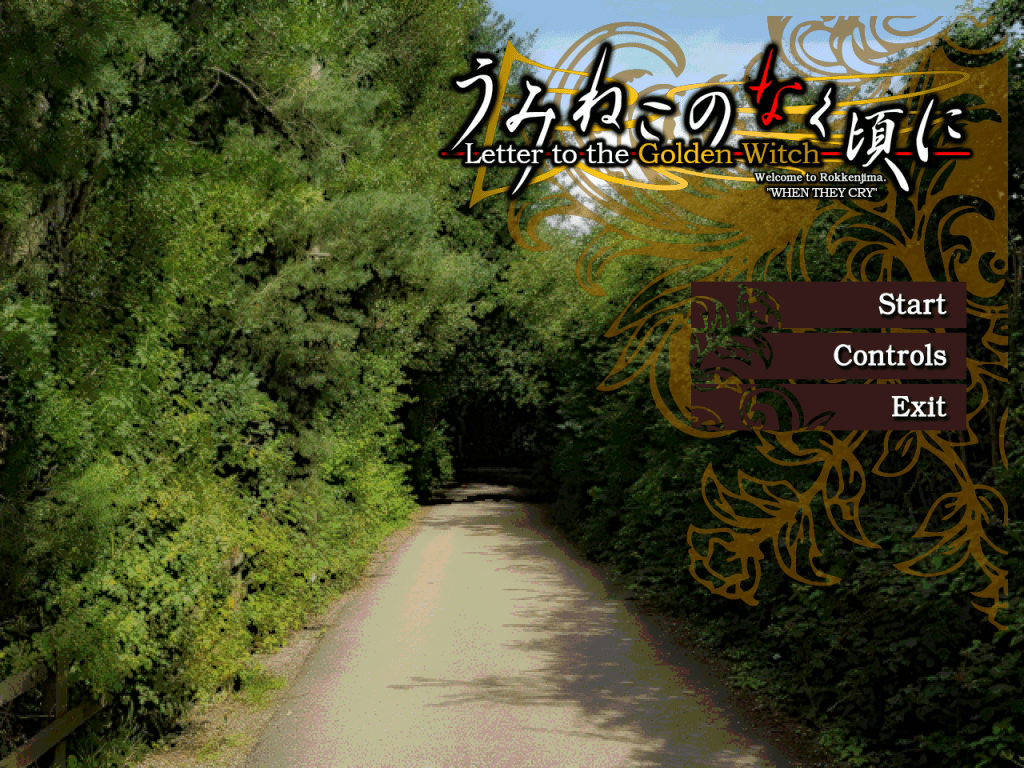
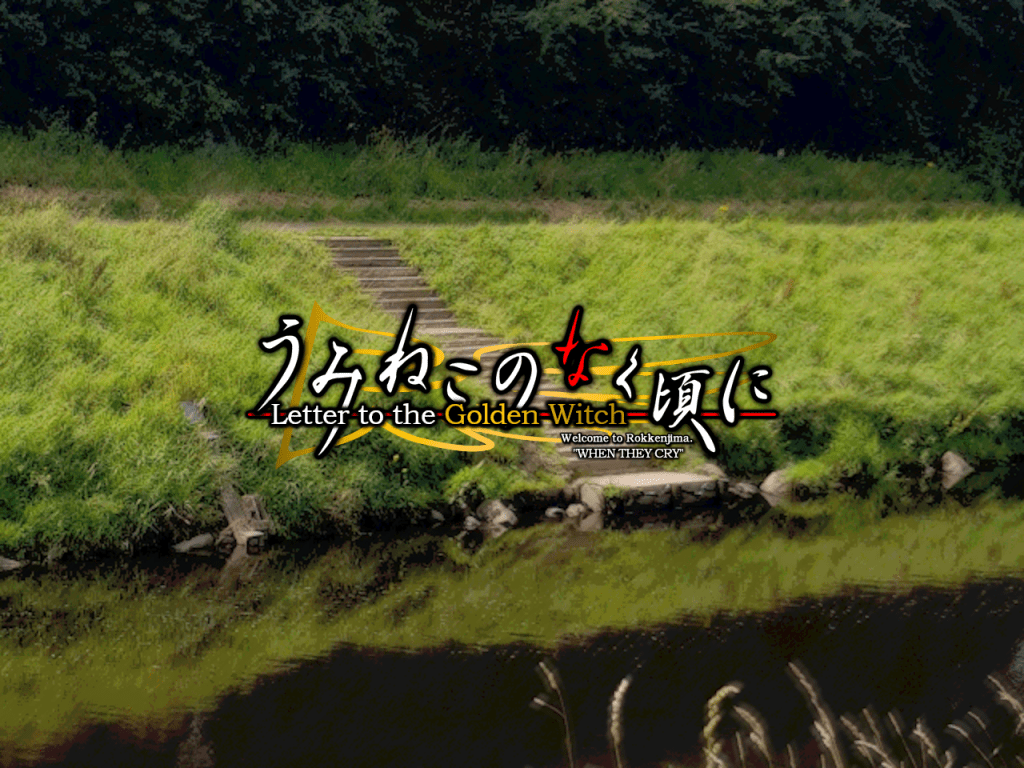
After a brief disclaimer and the standard dev/publisher logos for Answer Arcs, we get to the title menu! The background here is, like all of Letter’s other original backgrounds, a photograph from quite close to my home. I tried very hard to replicate the Umineko BG filter look and I think I did a decent job – it’s pretty hard to get right, but fun because different source images will demand tweaking based on their color palette and level of detail.
This particular background was an easy choice for the image that would greet the player upon launching the game; it’s a path that leads from the warm sunlight into the dark unknown – not only is it an unfamiliar image of an unfamiliar place, but that place itself elicits feelings of mystery and intrigue. I also chose to use a wind sound effect rather than the typical seagulls-and-waves main menu sound that Umineko normally opens with, intending to double down on that sense of mystery from the word go. Where does this path lead? Well, why don’t we click play and find out?
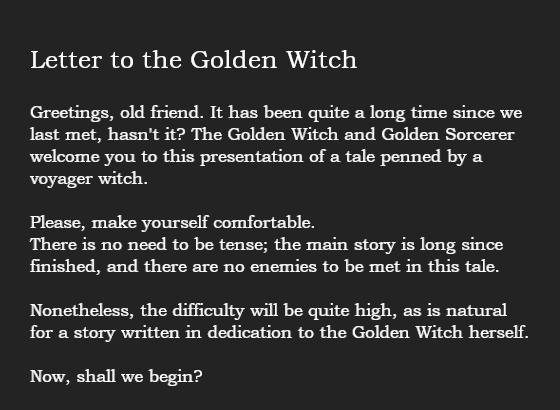
Please, make yourself comfortable. There is no need to be tense; the main story is long since finished, and there are no enemies to be met in this tale.
Nonetheless, the difficulty will be quite high, as is natural for a story written in dedication to the Golden Witch herself.
Now, shall we begin?”
When we go to start the game, we’re greeted with this little summary. This was one of the first things I ever wrote for Letter, long before most of the first draft was even finished! I intended to go back and rewrite it at some point, but I ended up being quite fond of it and never changed it in the end. I think it does a good job of establishing reader expectations while playing in the same sort of “witch’s invitation to a game” space as the original work’s episode summaries.
Prologue
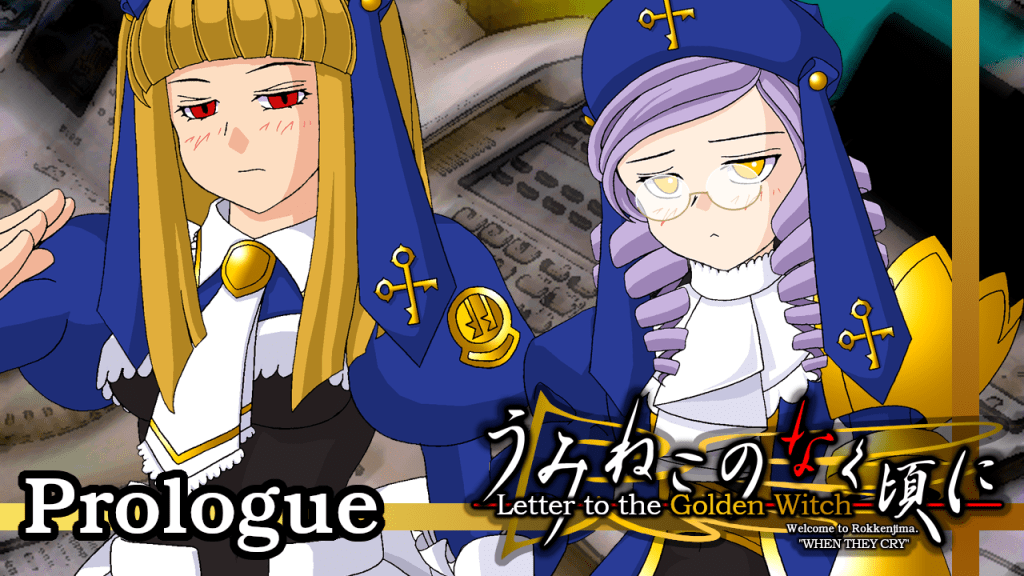
P.1 “Here, in the Sea of Fragments”
We click through and the game begins in typical style with a repeat of the “no affiliation” disclaimer, plus the usual “this story is obviously fantastical in nature” disclaimer.
After that, we get a quote from Umineko Tsubasa, an official short story collection released in 2010. Though I forget exactly which story the quote originates from (was it from a bonus epilogue you unlocked after reading all the others? It’s been a long time but that sounds about right), it really spoke to me when I first read it, as an open invitation for Umineko fans – we voyager witches – to write our own forgeries. This quote, like the others seen later on, is set to the familiar sound of ocean waves to evoke the Sea of Fragments, the place within Umineko’s own fiction wherein all of its infinite possibilities, fan-written forgeries included, can exist.
This, I think, nicely summarizes the driving force behind Letter – my own desire to write a forgery simply for its own sake – and also invites readers to accept forgeries as parts of Umineko’s mythology, natural consequences of the story’s rules and themes. That probably wasn’t entirely necessary (the reader is already reading my fan work, right? I don’t need to justify its existence to them) but it’s here anyway! More on that in Chapter 4.
P.2 “Eiserne Jungfrau”
At last, we get to the first full scene. This was the first part of Letter to be completed in full, written in mid-2020 as a proof of concept – long before I knew where I would take the rest of the story, before Etna even had a name – and remains largely unchanged from that time. As a result I think it’s a little crude from a presentation standpoint, but I’m still proud of it as a piece of writing. Making something small that I could be proud of really motivated me to keep working on this story!
Back when I released the demo, people seemed to really enjoy Dlanor’s characterization here; an acknowledgement that despite the rigidity with which she conducts her work, she’s still a caring person who cares deeply for her friends, and would be willing to bend the rules on occasion to do the right thing.
When she’s thinking back to the Golden Land – that she hasn’t been there in so long, and that she misses it so dearly – I’m sort of unintentionally appealing to the reader’s presumably immense love of Umineko and the fact that they probably miss it too. That sort of nostalgia, longing to experience the feeling of Umineko again, is a really huge part of Letter that will come up again and again. Here, it’s Dlanor missing her friends at the Golden Land – later, it’ll be Etna’s distant inherited memories of Rokkenjima, the Writer’s desperate and doomed attempts to reclaim Umineko’s magic, and even Beatrice finding comfort in ruminating on her past. The song at that moment, “In the Sun (Hidamari)” was a natural pick because I think it captures that sort of yearning in a warm, optimistic way that also really emphasizes Dlanor’s characterization thus far.
Speaking of music, I deliberated for a while about the song to use at the very beginning of this scene – I flip-flopped for a long time between using “Rest” and “Voiceless”, eventually settling on Voiceless for the 2021 demo (and then flip-flopping more until I settled on Voiceless for the full release). I think I overplay Voiceless a little bit (it comes up 5 times throughout the whole episode, when most songs only play once or twice), but it’s a very effective tone-setter and is low-key enough that it doesn’t end up being distracting to hear it a lot.
As an aside, the line “sighing allows happiness to escape” is something Gertrude says during the side story “Cornelia the New Priest”. I really liked that particular story from a side-character-slice-of-life angle before I’d even started working on Letter, and it was a big influence on my choice to use Eiserne for the prologue. I’m not convinced it’s a great line or that it necessarily improves the scene with its presence, but it felt important to include that little nod.

I’m still really pleased with some of the little gags in this scene: early on with the extremely long lines about how boring business is in the Eiserne offices, Dlanor whipping out the Red Key in her imagination and frightening Virgilia and Ronove, and later on using the longsword smash sound effects for the receptionist reading out Dlanor’s vacation time and the slow pan up while JUSTICE plays when Dlanor decides to take a whole two days off.
In general I think that playing with the VN format for comedy’s sake is an important “Ryukishism”, but also learning to joke like this early in the writing process helped me a lot when it came to emphasizing more dramatic moments in the script later on.
P.3 “The Voyager Witch”
After Dlanor heads off to the Golden Land, there’s still a little more prologue to go. We go right back into a black screen with the same wind SFX from the menu playing again. This takes us out of the story a little bit – which is appropriate, because the narration is now coming from a mysterious voyager witch who appears to exist not just outside the story, but as an observer to a world of readers and writers much like our own.
The narration here introduces some major recurring themes – the butterfly effect, for a start, as well as the relationships that readers and forgery authors have with Umineko – but it also, briefly, directly centers the reader by chellenging them to a simple red truth puzzle. This and the earlier difficulty comment on the title screen hopefully serve to remind players that this is a game they should try to solve, and (perhaps optimistically) primes them for the sorts of red truth word games that form the crux of several puzzles later.
We also cross the threshold that is the tree-lined passage, bringing us to a set of steps by the river. This is literally the path to the riverside steps near my home, but also establishes a sense of place, setting a location – the river – behind that dark threshold, though at this point the river’s significance is still unknown.
P.4 Opening Credits
This is another relic of early development that I intended to change at some point but ended up becoming attached to: a credits sequence in the slideshow style of those from Umineko’s earlier episodes. It even plays the very same song, “Ride On”, as it goes, hopefully dialing up the nostalgia a bit.
All of these names are obviously familiar, except one: who’s “Etna D. Alighieri”? Many readers would probably notice that she shares her surname with Dante Alighieri, the poet who wrote the Divine Comedy which Umineko repeatedly references.
Particularly eagle-eyed readers will notice that “Etna D.” is “Dante” backwards. I’m not sorry about it. It was actually my wonderful friend NARFNra who came up with the name, a fun multi-layered reference to both Umineko itself and Etna’s relationship with Beatrice that I fell in love with immediately and ended up commenting on within the script itself.
Next: Chapter 1
That’s it for the prologue, and I’m looking forwards to digging into Chapter 1! It’s a bit of a rollercoaster that includes some of my favorite writing from Letter, but also features Letter’s most cursed scene that I had to rewrite about a hundred times and never ended up feeling happy with. We’ll also meet our two key protagonists: Etna and the Writer, so there’ll be lots to talk about!
Okay, it’s time to get into Chapter 1! There’s an absolute ton to talk about here.
As before, there are Umineko and Letter spoilers below the read more! If you haven’t already read Letter, please check it out on itch or youtube!
1.1 The Golden Land
Before we get started, the editing across this scene was much more involved than in the prologue with Dlanor and Gertrude – characters move about and emote much more, and background changes are used more often to create a sense of 3d space and movement. I’d say that, out of the early scenes in Letter, this was the one that helped me get to grips with editing the most.
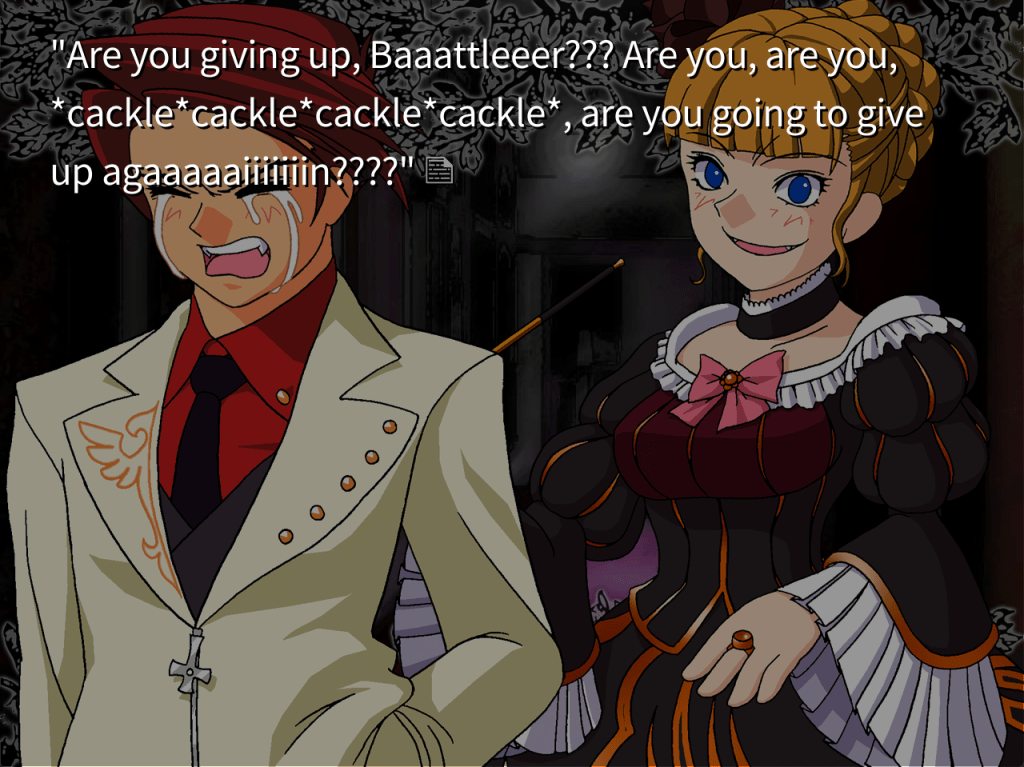
And we’re right into it! The first thing we see is Battler getting pushed about (again) in a mystery game with Beato. I always liked to imagine that the Beato and Battler of the Golden Land would spend their endless free time playing mystery games with each other. This sequence is also a pretty direct callback to the prologue of Episode 5, with the sudden cut from white timed to the intro of Miragecoordinator.
After Beato and Battler’s little spat ends, the song “In the Sun / Hidamari” plays again. In general I wanted to avoid repeating songs too closely, but in this case we’re referring back to Dlanor’s reminiscence about the Golden Land – as if to say, “this really is the Golden Land that Dlanor remembers, and it’s just the same as ever”. And aren’t we, reading this scene, indulging in a little Umineko nostalgia by reading this?
The whole scene is indulgent, really. We get repeats of Umineko’s old character dynamics – Beato and Battler’s whole thing, Ange and Mammon are still spending quality time with one another, and Beelzebub and Lucifer don’t seem to have changed a bit, either.
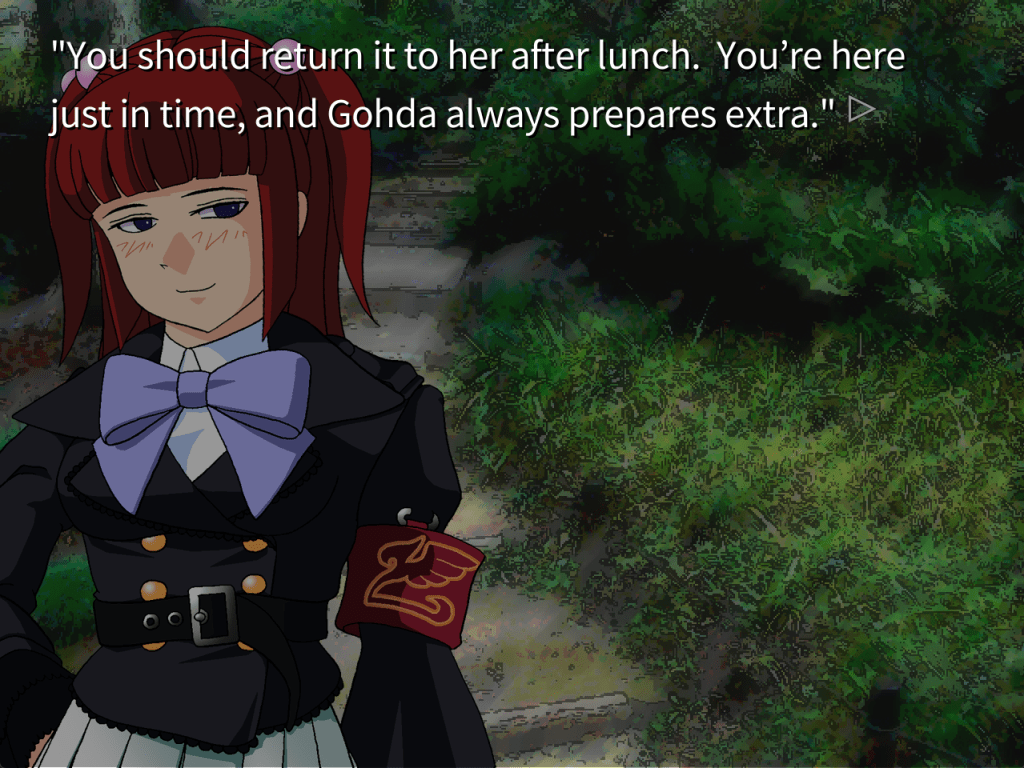
We get a little more intrigue when Dlanor explains the purpose of her visit to the Golden Land – Mammon seems pretty certain that the piece isn’t Beato’s, so whose is it? – but Ange dispels it pretty quickly by bringing up lunch. This is pure projection on my part as a LUNCH LOVER. I am, like Ange in this scene, known to interrupt plot moments to say “let’s get food” IRL. It’s good for pacing.
I’d love to pretend that it was a stroke of genius (and several readers have commented on it, referring to it as such), but Dlanor’s “I’m starving to <DEATH>.” line was not my work, sorry. I stole it from a Cornelia the New Priest line, “You’re annoying me to <DEATH>.” I’m sorry for tricking you into thinking i was that funny.
The number 34 turning up in the explanation of Golden Land Dining Room Logistics was a coincidence. There’s more silly little indulgent moments – Gohda’s doing his typical thing, and also he’s getting lessons on culinary magics? – and then we finally get a little bit more of the mystery.
Beato doesn’t recognize the piece, and it has no identifying marks – it’s the work of an outsider witch. Who exactly created this piece, and why…? I also repeat the song “Melody / Sirabe” again, calling back to Dlanor having asked herself the very same questions. This is one of my absolute favorite Umineko songs – I love its mysterious and sad, but still slightly playful vibe – and it was hard to resist the urge to put it in even more often than just these two times.
Anyway, at last, Beato makes the decision to summon the piece in the hopes of finding out a little more about its nature, though there’s an important point being made that Beato’s endless magic, despite being extremely powerful, may not necessarily be capable of repairing the piece entirely. I wanted to establish this early rather than explaining it after the fact, and this was a very natural place to do so – it didn’t make a huge difference overall, but I think as a general rule that it’s best to get ahead of these things, and that it makes a story feel much more well thought-out overall.
1.2 Etna D. Alighieri I
Rather than spending more time faffing about, we jump right into the summoning of the piece. Let’s finally discover just who this piece is!
It was fun to edit the summoning magic in this scene. The music and crowd sounds cutting out when Beato begins the spell, the familiar sound of the butterflies appearing, and then a flash of white— and then, Etna appears.
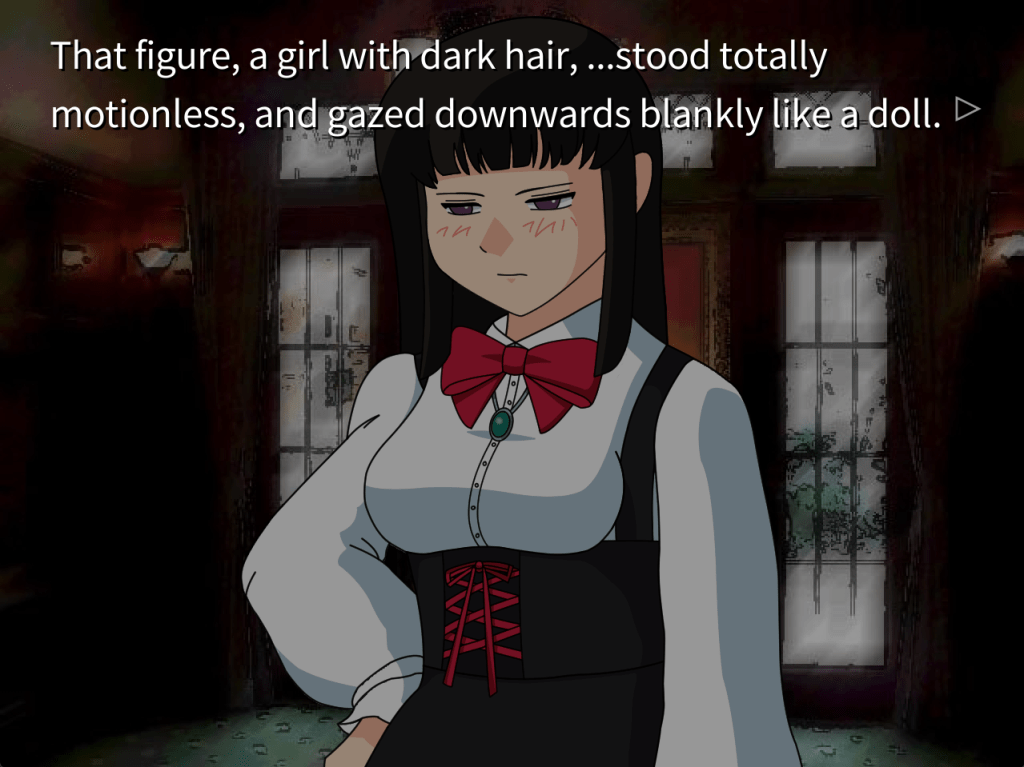
Etna’s sprite was the commissioned work of a friend of mine, who drew her up with a handful of expressions. I ended up doing a lot of touch-ups to make her ready for in-engine use, as well as adding a bunch of new expressions myself, but I’m certainly no artist and none of that touching up would have been possible without Zappa’s excellent base work.
The original idea for Etna’s visual design was to, without changing her appearance much if at all, fit in both as a human and as a witch. This ended up not really mattering because the second use I had planned for this sprite never ended up coming to fruition – I’ll talk more about that right near the end, though.
Etna’s expressions were great fun to work with (I think they fit in with R07’s sprites incredibly well!), though in hindsight I wish I’d taken more of a draw-them-as-I-need-them approach rather than creating 40 or so all at once and having to script around them. There were some emotions that original set of expressions wasn’t really capable of conveying, and at times I had to make fairly substantial changes to the script so that I didn’t veer too far from what she was actually able to express. I did make some new ones later on, which helped out a lot.
Regardless, Etna immediately collapses. It seems that Beato’s warnings – that her magic may not be able to fully repair the piece – were well-placed.
1.3 The Writer
I actually originally intended for the whole “Witch and Writer” storyline to be much shorter and to take place entirely in the tea party, though it didn’t take long before I realized that interspersing these scenes all throughout the main episode and tea parties was a much better idea.
This scene starts with one of my favourite lines in the whole VN: “Nothing bad happened today. …..But it was a bad day.” This character, the unnamed Writer, is quite transparently an expression, sometimes exaggeration, of many of my personal struggles and insecurities. Here, for her introduction, she’s deep into a depressive pit where every day is bad even if nothing bad actually happens, and where she’s already doubting her own love of the story that she turns to for hope and inspiration.
The song “Wingless” playing here draws the reader back to Ange’s story in Alliance. Like Ange was back then, our Writer is a person who exists “outside” Umineko as we know it, whose relationship to Rokkenjima is that of an observer. At a slight stretch, you could say that it reflects the Writer’s personality somewhat: she sees everything in terms of how it relates to Umineko, and so her sadness is like Ange’s sadness. The same song plays for both.
I wanted to use original backgrounds for the writer’s bedroom, but I settled on using the Hachijo mansion study from Episode 6 instead, since it already had day, night and rain variants that I could use to convey the passage of time.
Nonetheless, the Writer explains her dilemma. She’s trying to write her own story, in dedication to Umineko (though she only refers to it obliquely as “The Golden Witch’s tale”), but she’s an inexperienced writer and is stumbling before she’s even reached the first hurdle. In this scene, rather than trying to tackle her problems, she just gives up and returns to bed, hoping that tomorrow will be better.
1.4 Etna D. Alighieri II
Etna Awakens
Etna, name as yet unknown (but easy to guess, considering its appearance in the opening credits) wakes up in a familiar room.
The song “Le 4 Octobre” starts playing at the line about Etna finding the room familiar. This is a little presentation trick I really like – emphasizing a particular line by playing a song alongside it, giving a vague impression that the contents of the line are sort of a defining theme for the scene to come. It’s as though the song is picking up the meaning of its associated line and carrying it through until it stops playing.
Etna’s Conundrum
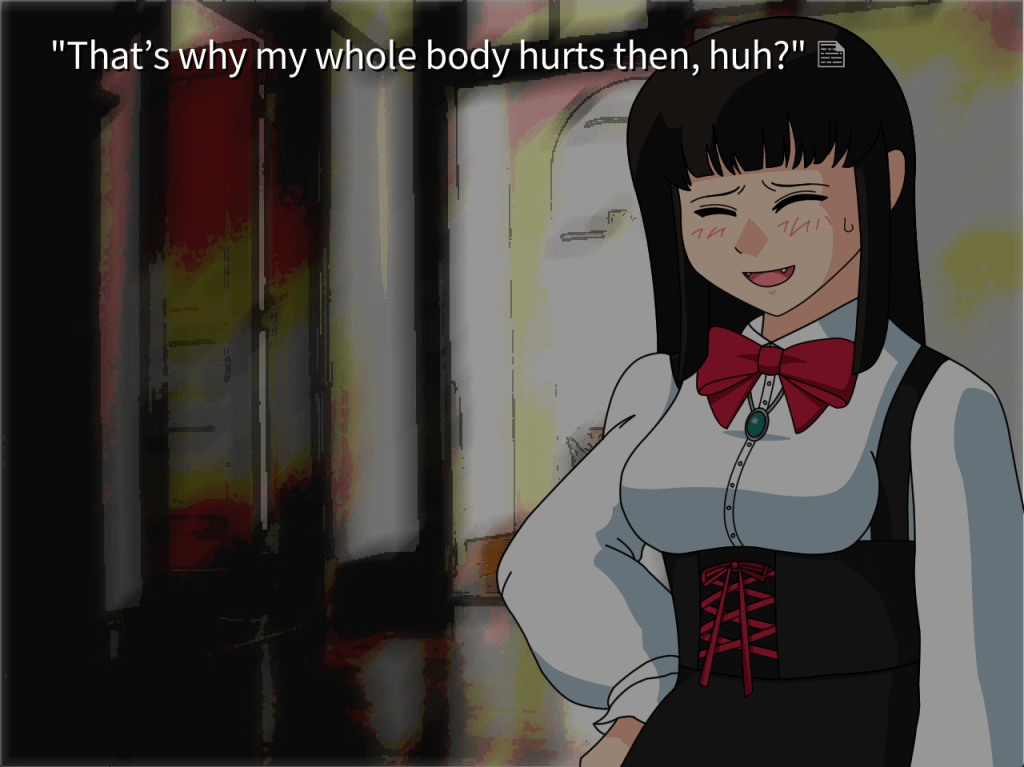
The part of this scene after Beato and Battler arrive was actually by far the hardest to get to a happy, finished state. At multiple points during the writing and editing processes (including after finishing everything else just before release) I spent days stuck on it, and to be honest I don’t think I ever quite solved it.
The overall scene had four main goals.
- introducing Etna’s character, her basic relationships with the other characters, and endearing her to the reader
- establishing the details of Etna’s conundrum & offering potential solutions as motivation for the rest of the story to move forwards
- getting the reader interested in the mystery of Etna’s creator
- being good
The biggest issue, really, was that Etna’s conundrum was difficult to explain concisely, sand much of it is also speculation on Beato’s part, so it means you’re reading pages of exposition qualified with “maybe??? If I’m right in the first place???”.
Its place in the story was also problematic, as by this point there’s been no time at all for the reader to get to know Etna before the focus suddenly shifts away from her as a character and towards establishing plot devices. She’s still present in the scene, but her role now is just to react point-by-point to the mountain of information Beato is giving to her, more a pacing aid than anything else.
Despite the huge amount of attention this scene was given, ultimately its problems were structural, borne of a clash between its need to simultaneously introduce Etna as well as the problem she faces, and a better result would have come from fundamentally restructuring this early part of the story to do these two things at different times. Short of a somewhat radical rewrite (which would have made this early part of the story considerably longer, at that), I still think I did a “good enough” job here. Frontloading this exposition about Etna’s present circumstances gets it all out of the way, if nothing else.
We also get a couple of big hints to chew on regarding the identity and motives of Etna’s creator, specifically in the section about “task-bearing furniture”; that is, that she was likely some sort of untrained witch, inherently talented in magic, who summoned Etna without an explicit spell or ritual for the purposes of completing some particular task.
Etna & Mammon

After Beato and Battler leave Etna to her own devices, she and Mammon have a little conversation about how they, as furniture, relate to the ideas of purpose and greed. I liked this section a lot, since it’s an interaction between two characters who share a lot of similarities and otherwise don’t end up speaking to each other. Mammon is really fun to write because of her peculiar outlook on life, and just from a plot perspective I think it’s really important for someone to give Etna a pep talk considering the dour tone of her conversation with Beato and Battler.
This also gives us a chance to get to know Etna a bit better. Right at the beginning of this section, she uses her prior understanding of Rokkenjima and its residents to convince Mammon to talk to her, a small moment that finally has Etna taking charge of the scene rather than passively reacting to it, even though Mammon ends up mostly leading the conversation from there.
It might have been nicer to find some excuse to use a different location, though – having so much happen in this little 3-background room without a break is tiring, and makes the three distinct sections of the scene (Etna wakes up / Beato explains Etna’s dilemma / Etna talks to Mammon about it) blur together in a bad way. This is another problem that definitely could have been solved by splitting things up a bit more, rather than trying to pack so much into one scene.
Next: Chapter 2
We’re done with Chapter 1! In the next chapter, the introductions will finally end and we’ll move on to the story proper: Etna’s game, and the relationship between the Witch and the Writer. Chapter 2 also includes some of my favorite jokes from the whole story, so I’m looking forward to commenting on those.
 erin's site
Leave a comment