
Despite all of the change it brings, both broad and deep, ELDEN RING Reforged is careful to still be ELDEN RING.
At ELDEN RING‘s conclusion, having slain the very gods, our lowly Tarnished holds the power to reshape the Lands Between as they see fit. Depending on their choice of ending, they mend the Elden Ring and re-establish the golden order, or institute new order, or simply allow the world to determine its own fate.
Few games could be more appropriate, then, for a small team of mod developers to take it upon themselves to change in its entirety. If those devs are the Tarnished, then Reforged is a Mending Rune and ELDEN RING is, well, the Elden Ring — but what age does their vision bring to the Lands Between?
I’ve been enjoying ELDEN RING Reforged for a few months now, having sunk my teeth into it proper after returning to the game for the release of Shadow of the Erdtree. I’ve wanted to write about it (and I already have done), but it’s difficult to write just a little bit about ERR. Though it has plenty of flashy headline features, it is primarily a work of very wide scope, making a vast number of small and subtle changes to just about every single aspect of ELDEN RING.
Even if it makes writing about it difficult, this exhaustive and all-encompassing vision of ELDEN RING‘s potential is the mod’s true appeal. ERR rebalances and tweaks every last mechanic, leaving no stone unturned in its mission to turn a vast and oftentimes messy game into a tighter, more cohesive experience — all while deftly avoiding transforming the game into something other than itself.
Reasons to care, and a careful touch
As I’ve written about before, ERR sets out to give players many more reasons to engage seriously with parts of the game they’ve already played in vanilla, and even with parts they may have ignored outright before.
New and more fleshed-out build options and tool synergies make it more exciting to find new items and play new characters. Rune Pieces (and in the DLC, Ember Pieces) give reason and reward for scouring every last corner of the game, enemy camps and the codex make previously pointless open-world encounters worthwhile. Enemies and the player’s toolbox — core mechanics and build options both — are rethought and rebalanced to make boss fights fun and fair, worth fighting rather than worth cheesing.
These features serve to draw every minute of value out of the ELDEN RING that already exists. Compared to the base game, overall progression and item locations are largely untouched1, except to remove some skips and overpowered early leveling strategies, and enemy encounters are mostly the same besides camera fixes and minor tweaks to egregious damage or hitboxes on certain bosses.
What entirely new content there is mostly fills gaps, fitting into conspicuously sparse parts of the game — like Redmane Castle, turned from an empty fort into a mini legacy dungeon complete with a new boss — or tucked neatly into small but suitable locations like the new endgame bosses Crucible Knight Hirnan and Hallowed Avatar.
The few changes made to progression itself largely serve to steer players towards more exploring, not less. For example, alongside other reworks to how smithing stones are obtained, appropriately-leveled smithing stones are distributed to each optional dungeon boss, making every dungeon potentially worthwhile to any player even if the regular reward would be irrelevant to their build. This, in concert with increased rune gain from optional content and all bosses granting Rune Pieces, is a great example of how fairly subtle tweaks and additions put ERR‘s overall philosophy of “increased engagement” into action.
The player’s toolbox
The vast majority of changes made in ERR are, in one way or another, changes to the player’s core combat mechanics and build options, but this is only natural. With the player’s progression through the world itself being almost identical to vanilla, the approach to squeezing a more deeply engaging game out of ELDEN RING is instead to address the ways in which the player interacts with that world.
Core mechanics
Combat can still be approached in largely the same way as in the last decade and a half of FromSoftware titles, but that would be missing out on a lot of fun new mechanics.
Backsteps are replaced with an on-the-spot duck to avoid head-height slashes and thrusts (and much more), codifying ELDEN RING‘s tendency for attacks to accidentally whiff into an intentional, rewarding mechanic with a powerful niche. Offhanded weapons are given the ability to block, which becomes very useful with the implementation of a deflect mechanic that negates damage and heavily reduces stamina loss on well-timed guards. And no matter your weapon or playstyle, you stand to benefit from the Perfect Actions system, a just-frame sort of mechanic which rewards you with slightly improved attacks, spellcasts and dodges if input within a tight window during your previous action’s recovery.
Alongside universal reworks to attributes and weapon scaling, spellcasting and FP in particular see some core changes. FP now regenerates slowly in battle, as well as being recovered slightly by attacks, but certain spells are also converted into “generators” with low FP costs and damage, but high FP recovery on hit. In addition, almost all weapon skills are dramatically faster, allowing them to better fill whatever niche a player might require rather than competing directly with simple charged heavy attacks (or Bloodhound Step).
These changes alone are quite substantial, and define ERR‘s moment-to-moment gameplay. Some previously troublesome attacks are handled well by creative use of ducks or deflects, and Perfect Actions are a constant, minor way to reward you for paying attention and learning your moveset’s timings more precisely. None of these things shift the balance of power too dramatically in the player’s favour, although deflects in particular are extremely strong, but they’re fun to use and give you more ways to handle enemies regardless of your build.
Fortunes guide your fate
One of the flashier features ERR boasts is fortunes, an optional class system which allows players to further specialize their character with a set of passive buffs, drawbacks, and unique mechanics.
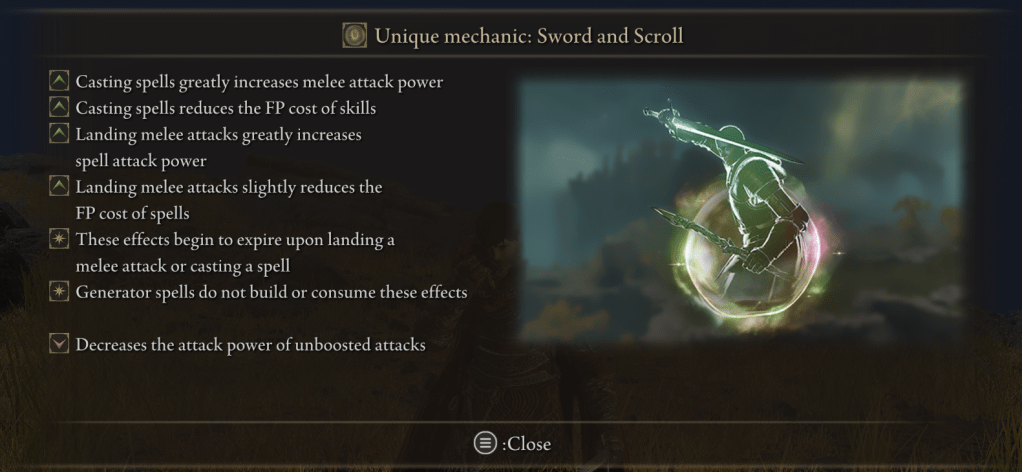
Fortunes run the gamut from broad like the Sage which boosts spell power and increases natural FP regeneration when casting a spell, to extremely specific like the Crucible which restores HP and gives unique buffs to the player every time they cast an Aspect of the Crucible incantation. Most fortunes are readily available from the start of the game but rare and legendary fortunes, which tend to demand more specific playstyles, have to be found throughout the game.
The list is long and covers all sorts of character archetypes and playstyles: there’s the Apothecary, primarily dealing damage with (also reworked, of course) craftable and consumable items, the Heretic which grants buffs whenever status effects occur in their vicinity, even significant HP and Stamina regeneration if three different status-actived buffs are active, even the recently added Fortune of the Reeds which replaces two-handed guard animations and mechanics for katanas and small swords with those from Sekiro for the ultimate deflecting samurai playstyle.
My personal favourite is Dynasts, a bleed-focused legendary fortune which spawns a blood pool on the ground whenever you or a nearby enemy suffer blood loss, which provides numerous buffs like stamina recovery, movement speed and even HP restoration when attacking. This creates a fun dynamic wherein you’re encouraged to stay close to your blood pools, holding your ground rather than chasing after or being chased away by your opponent.
Fortunes are one of ERR‘s most impressive features, subtly guiding players towards more dynamic and unique styles of play — without being too restrictive — and also serving to differentiate each playthrough and character from one another. This works really well in multiplayer with Seamless Co-op, as each player can feel like they fill a defined role in their party.
Though far from the only exciting, build-defining options presented to the player, fortunes exemplify ERR‘s approach to both broadening and deepening the player’s toolkit. They and other features like Binding Runes and Shadowed Curios, as well as rebalances and reworks to weapons, spells and even status effects, fit surprisingly snugly into the framework of ELDEN RING to result in a game more engaging both in the small and big picture than vanilla ever was.
A thousand year journey, guided by balance
ELDEN RING has always expected players to experiment and find solutions to the problems presented by its challenging bosses, but Reforged subtly adjusts the meet-bullshit-with-bullshit dynamic by giving players a far deeper, more well-balanced set of tools with which to tackle their enemies.
Previously overpowered strategies like bleed builds or use of the Mimic Tear are weaker than before, but they remain fun and perfectly strong. Spirit Ashes are totally retooled, being cheaper to summon but weaker and not targeted by enemies until enraged for an additional FP or HP cost, which drastically increases their damage output and enemy target priorty, on top of activating a more aggressive AI package.
Likewise, changes to the hemorrhage status effect make blood loss weapons ostensibly weaker against bosses by scaling its damage depending on the enemy in question, but dealing more damage with each successive proc against a single target. With status-based fortunes like Heretic and Dynasts, or others like Reeds for specific weapons, there are only more ways than before to play with these particular toys, even if they’re less straightforwardly powerful a lot of the time.
Within the constraints of whatever playstyle or build you’ve chosen, you’re still expected to find an answer to each situation. You can’t stubbornly midroll your way through everything, nor can you simply summon a mimic tear and start shooting lasers to trivially turn every boss into paste before they can do anything, but you’re still heavily rewarded for knowing your build’s weaknesses and covering for them with smarter use of new system mechanics or clever application of specific tools.
It’s a tight balance, but one that is struck incredibly well, and it’s reinforced by some broad numerical changes. Enemies still possess elemental resistances, but these are now capped at 50%, meaning element-themed characters won’t run into a wall versus resistant foes in the same way that, for example, holy damage suffers in vanilla against lategame bosses — but still encouraging players to make use of a variety of damage types if need be. To this end, ERR conveniently offers each given statline a wider variety of damage options, with more affinities and some unique weapons reworked to fill this sort of niche; for example the Dancing Blade of Ranah in the DLC, a lategame offering which now uniquely deals dex-scaling fire damage.
This slightly relaxed, but still very present tension between increased build freedom and the challenges of each encounter is the biggest strength of ELDEN RING Reforged, and the main reason that I and many other fans of the mod will keep coming back to it: there are always going to be more new perspectives from which to see the Lands Between.
Starting from a game so large and so empty-feeling that it easily gets lost in itself, and without making overt changes to its essential structure, this replayability is a tremendous achievement on the part of Reforged‘s developers.
I was tempted to make this a deeper dive into everything that ERR offers to both fans and critics of ELDEN RING, but it was impossible to do that without simply writing way, way too much. If you’re interested in a more comprehensive record of ERR‘s changes, there’s a wiki to pore over, though it has yet to cover the the new features of the 1.0 release. Look at the fortunes page and see if anything takes your interest!
If you want to try ELDEN RING Reforged — and I hope you do! — you can find it here on Nexus Mods. It’s incredibly easy to install, with a very clever 1-click launcher that does everything for you and doesn’t directly touch any of the game files. Though its 1.0 release has already come and gone, it is still under active development with new content, features and changes added regularly.
If you want to support the hard work that goes into ERR‘s continued development, consider donating to the Ko-fi pages of lead developer Kirnifr and co-developer ivi!
- This said, there is an optional “Eternal Return” game mode which does make dramatic changes to progression, replacing the game’s existing structure with a time-limited loop where power is gained by completing NPC questlines within each cycle. ↩︎
 erin's site
Leave a comment